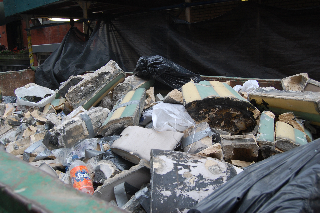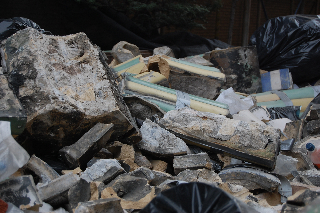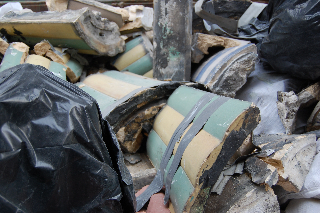
This just in [with photos] from BHB community member Andrew Porter:
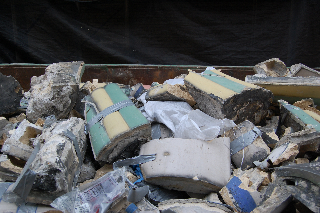
They are throwing gorgeous pieces of yellow and green and black art deco terra cotta into the dumpster on the Pineapple Street side of the St George Tower, just across from my building. It’s there right now. I suspect the dumpster will be replaced with another one tomorrow, when Alt Side of the Street empties that side of the street.
I’m going over to try to save some of the pieces. They look round, like they’re from chimneys.
This is sadly similar to the demolition of an art deco tile mural from the Easter Athletic Club, housed within the St. George, earlier this year.





Do consider that, at the turn of the century, when the St. George was built, they were using asbestos.
if they’re throwing asbestos in the dumpster like that, we have bigger issues.
I find everything that building does to be completely bone headed.
So did they ever end up replacing that deco mosaic with crack-free duplicate of it like they promised? What ever happened in that emotional saga?
Sadly, those fragments appear to be from the (landmarked, I might add) spires on the roof deck:
http://www.111hicksstreet.com/building/roof_garden.php4
The roof deck is currently undergoing renovations. The shareholders were informed that these spires would be restored and not demolished. The you know what is probably close to hitting the proverbial fan about now over there, I would suspect, or at least hope.
I’ve gotten into it here with other regulars who support the 111 co-op board, but they seem to “renovate” in a way that is … how can you put it? … not in the best interest of shareholders.
They need new blood there.
That is so sad.
This coop board seems hellbent on erasing any vestige that this building used to be a grand hotel. I can imagine the discussion…Those spires are unique…No, they’re old and too expensive to restore. Get rid of them. But don’t say a word, lest those crazy preservation types get wind of it.
Those are definitely from the roof. Call 311 to report a landmark violation! They can’t do this without a permit from DOB and Landmarks. This is tragic.
My last report re the mural demolition was that the replacement was a white wall. When I reported the destruction to Judy Stanton at BHA, I was told that landmarking only applied to the outside of buildings, so this new destruction is definitely a violation.
111 Hicks has killed history. They murdered Tea Lounge. Their finances are a mess. They are the AIG of coops.
Just retrieved some pieces. Past damage is clearly evident in some of them (e.g. caulked cracks) so I’ll step back on passing judgement as to the worthiness of preservation versus replacement. However, I can attest to the craftsmanship that went into this work. Solid concrete construction…even a small piece that measured 5″ x5″ weighed a good 2 pounds. Nice terrecotta.
Those items were decorative pieces on the roof. I don’t think they are visible to the public so the landmarks commission would not stop their removal. co-ops need to prioritize their expenditures.
Thank goodness the Parthenon is not controlled by a coop board.
I have always thought that 111 Hicks Street was a truly ugly building. If the whole thing were put in a dumpster tomorrow I would be just as glad.
Snoopy, the St. George Tower is from the 1920s — thus the Art Deco terra cotta elements — and not from the “turn of the century”. Also, terra cotta is not asbestos; it’s a baked form of masonry, with the colors in the surface. Think of it as pottery.
Alas, when a lot of the pieces were tossed into the dumpster from the top of the sidewalk shed, they were thrown onto each other, breaking and shattering larger pieces.
If you believe a violation exists, call 311 to report a construction violation or landmarks violation.
To restore the spires doesn’t necessarily mean re-using the previous materials. When you get your bricks repointed, some have to be replaced with, egad!, new ones. When brownstones get a fresh layer of brownstone stuff (whatever it’s called), they throw out the old layer. Oh my god!!! I’m not even sure that what it’s replaced with is the same material as the original brownstone.
As these were visible from the street, they are covered by landmarks. As far as I know, they have been a long time in replacing due to the difficulty and expense in replacing them in compliance with landmark status.
My understanding is that they were also a major source of water leaking into the building.
And isn’t it true that some of the restoration work at 161 Henry involved fiberglass replacements? I’m pretty sure that’s not original materials, yet everyone is so happy to see it completed and the sidewalk shed removed.
I don’t know why there are so many people hellbent on trying to bring down our buildingg. There are 40 of these spires on the roof, many of which have been cracked and damaged for years, causing water damage to drift down through the building and threaten its structural integrity. We are in the midst of $1.5 million restoration of the entire roof deck, all of which had been approved by Landmarks and DOB, and the terra cotta pieces will be replaced by fiberglass ones if they cannot be restored, even though they can’t be seen from the street.
As to whomever “The Where” is, our finances are in good shape due to diligent Board members, the Tea Lounge basically backed out because the owner is going down the tubes financially but he prefered to blame it on the negotiations with our builidng rather than speak truthfully to the press, (which, Homer you ran his unsupported accusations several times without questioning his veracity or motivations), and unfortunately, we had no control over the murals as that is within the space maintained by the Eastern Athletic Club, which has a 40 year lease that is not up for another 10 or 11 years
111, that’s all true. But the sight of art deco terra cotta pieces being thrown away hit my architectural button and my Deco button. Anyone who wants a piece of this stuff (Warning: it’s heavy) should go to the Dumpster and do a little diving. You can grab stuff standing on the street right next to the thing.
Isn’t the EAC lease up in less time than that?
I think the fiberglass cornice work on 161 Henry looks great. Doing it in the original sheet metal (or wood?) would have been possible, but costly and requiring more care. Landmarks is pretty good about this stuff. But doing those “florets” in fiberglass will be a shame. I’m surprised Landmarks (and the board) approved that idea.
I’m glad to hear the building is spending 1.5 on the roof deck. That’s a lot of money. Maybe they could publish the plan here — might make the neighbors get back on your side. From the outside, it seems like the current shareholders have been dismantling a real gem over the last decade. (I think for example that the mural was owned by the building and not the tenant and the threat of a lawsuit would have stopped that quickly)
I think we should all stop threatening lawsuits everytime we don’t like something or disagree. It’s part of what is bringing down this whole economy. Everyone take a deep breath. The materials are not salvagable and if you haven’t been part of the building or seen the financials than I don’t think you have the right to pass judgement.
There’s a lot of talk and conjecture going on here. Has anyone actually called 311 (is that the Landmark Commission) to check out the assertions of 111 resident?
111 Resident – we’ve reached out to your board, they never respond to us. We’d gladly run your side of the story anytime. Contact us at : webmaster at brooklynheightsblog dot com
What’s the difference between the fiberglass at 161 and the towers at the St. George? Oh, the towers at the St. George are about 200 feet higher up and will be IMPOSSIBLE to tell the difference between terracotta and fiberglass from street level.
I imagine it would have been possible, albeit more costly and requiring more care to replace in the terracotta.
Is this inconsistency of your argument not crystal clear?
The private corporate that is the co-op (St George or any other) does not need to divulge its private financial status or to explain its actions to its own property as long as it is within the building code and landmarks approval (where applicable).
I think the difference is you’ll see them up close when you’re standing there. They’re right there! From the ground it doesn’t matter at all.
Nobody is saying they can’t do that. But when the Clark St building takes out it’s gorgeous lobby, when 111 Hicks loses the mosaic, when 111 Hicks loses these art deco gems… the whole neighborhood suffers. What I don’t understand is how — in this day and age and neighborhood where these kinds of details are prized — does this pass muster with shareholders (altho I’ve heard there has been some backlash).
Nancy, I’ve seen the financial statements. So I get to pass judgement? Excellent.
What surprises me is that the board, having caught so much flak after the mosaic incident, once again has turned a deaf ear to its neighbor and went about destroying original elements of the buildings architecture. Did they consult any salvage companies that would have actually paid them for these pieces? Or perhaps the LI Historical Society? Whether they replace these in fiberglass, terra cotta, or Silly putty is besides the point now…the originals are lost in a heap of debris. My problem is not with the need for their removal but the process by which it was achieved.
Wow. Another tempest in a cracked teapot. God forbid anyone can repair or replace damaged things in this neighborhood. Nancy is right; no one has any information regarding whether they are putting up facsimiles of the old, cracked and repeatedly repaired terracotta that they removed. Restoration work doesn’t always mean preserving every piece of original material. This isn’t an archeological site, folks, and even the Notre Dame has replica statues carved by modern sculptors to replace the ones that were worn down or damaged over time. If the 111 resident who posted above is right that there was leaking and roof damage being caused, then they have a right to repair it and replace these spires with new copies. You guys scream about eminent domain abuse all the time, but you clearly don’t really believe that individuals have rights regarding their own privately owned property and how to maintain it. Rather, you use the BHA and LPC as your proxy nanny to control individual freedoms of your own neighbors because their actions offend your sensibility of what is historic or correct, even though you do no research and know little about what the case actually is before flinging accusations and rending your collective garments in agony over the lost past. Get a grip on reality…
The disrespect for the people who want to protect and preserve a neighborhood that has been declared an historical landmark is really inappropriate. BrooklynHeights was rescued from demolition at the hands of Robert Moses by a dedicated group of citizens who worked long and hard to save most of the neighborhood. Your building would have been replaced by the BQE, etc., so there would have been nothing to save. Of course, things need to be repaired and if there is approval by the Landmark Commission, there’s nothing to complain about. It’s hard for some neighbors to know this when they see a pile of art deco tiles or destroyed roof columns in a dumpster, and it’s gratifying that they care enough to care about the past. That’s what living in Brooklyn Heights is all about. In all historical areas such as Georgetown in DC each individual cannot do as they please without approval.
My2, imho, the argument isn’t against the need for long-overdue and much-needed repairs or the nature of the replacements, which the board has appropriately done within LPC guidelines, but the cavalier way that they destroyed the original pieces. Do you happen to know if the original sculptures on Notre Dame ended up in a dumpster? I seriously doubt it.
I mean no disrespect whatsoever to the idea of historic preservation, and believe in it fervently. However, I differentiate between preservationism on the scale of saving buildings from destruction by developers and the city (as with Moses) vs. nosing around neighbors dumpsters and jumping to conclusions about their motives or integrity before getting all the information. Nabeguy, are you seriously equating these tiles with precious artifacts? I mean, do things have to be so black and white? Why can’t we make educated value judgements about the relative historical significance of things rather than have these knee-jerk overreactions all the time?
You are absolutely right Nabeguy. The original sculptures from Notre Dame are beautifully displayed in the Cluny Museum in Paris – not far from Notre Dame on the Left Bank.
my2, the value judgements you refer to are dependent on how exactly you were educated. How would you define “precious”? Does an object have to be 1000 years old or of Byzantine quality to pass your test? Given the ready-made, disposable culture that we live in, I’m disturbed by our readiness and alacrity to chuck out everything that preceded us. If you truly believe in historic preservation, than why can’t you buy into the argument that these spires could have been removed and put aside for adaptive re-use rather than destroyed? They would have made impressive entry pieces n the 111 lobby. I’ve argued this before…the mindset that allows for small destruction only leads to larger swaths of it. I’ll have to stop now as I almost about smashed out the screen with my knee-jerk reaction.